
Translation
Accurate translation between languages from Buxonline freelancers, starting at $1.

 claratradsNew Seller
I will check your Spanish writing for mistakes and awkward phrasing, up to 400 words.
 5
5$100
 claratradsNew Seller
Quick translation for emails, product descriptions, or social media posts in neutral Spanish.
5$100
 ffnewid537New Seller
I will write clear Urdu content, type documents, and reply to customers professionally.
$100
 tehreemmirani98New Seller
I provide accurate and easy-to-understand English to Urdu and Urdu to English translation. I focus on correct grammar, clear meaning, and timely delivery. I am committed to providing quality work and client satisfaction.
$100
 tutorialbasedhubLevel 2
I will convert PDF to Word, Excel and format documents professionally.
$100
 aimanyaseen2005New Seller
I will translate your text from English to Urdu and Urdu to English with accuracy and clear wording.
$100
 Ahmad MajeedNew Seller
I provide high-quality translation services with a focus on accuracy, clear wording, and natural language. I can translate your text while keeping the original meaning and tone intact. My translation services include: • English to Urdu translation • Urdu to English translation • General documents • Articles and blog posts • Social media content • Website content • Emails and messages • Manual proofreading and editing I always aim to provide accurate, natural, and well-formatted translations. Send me your text and language requirements, and I will be happy to help!
$100
 sardorbekt127New Seller
"Ответственный и культурно грамотный переводчик английского, русского и узбекского языков
$100
 sardorbekt127New Seller
"Ответственный и культурно грамотный переводчик английского, русского и узбекского языков.
$100
 ai570709New Seller
Professional translation of up to 500 words from English to Russian or vice versa. Includes basic proofreading and formatting. On-Time Delivery: I respect your deadlines and always deliver projects without delays. Strict Confidentiality: Your documents and personal information are safe with me.
$100
 haseebtradinguk2008Level 2
I will provide accurate and fast urdu translation. 350 words for 1$.100% manual work,no google translat document,acticles,and posts.fast delivery
$100
haseebtradinguk2008Level 2I will provide accurate and fast urdu translation. 350 words for 1$.100% manual work,no google translat document,acticles,and posts.fast delivery
$100
haseebtradinguk2008Level 2I will provide accurate and fast urdu translation. 350 words for 1$.100% manual work,no google translat document,acticles,and posts.fast delivery
$100

 yellaNew Seller
I will provide clear, accurate, and natural translations for your documents, messages, captions, and other texts.
$100
 uk9564512New Seller
I will translate urdu to english and english to urdu accurately with fast delivery. 100% human translation, no google translate
$100
 uvinduananda02Level 2
Original articles, accurate translations and careful proofreading, delivered on time and written for your audience.
$100
 brianmirth23New Seller
traducir cantidades de texto de inglés a español o viceversa
$100
 72062New Seller
I provide fast, accurate, and natural translations for text, documents, websites, and more. I can help you communicate clearly across 70+ languages with professional and reliable service.
$100
 rafaelcortez0825New Seller
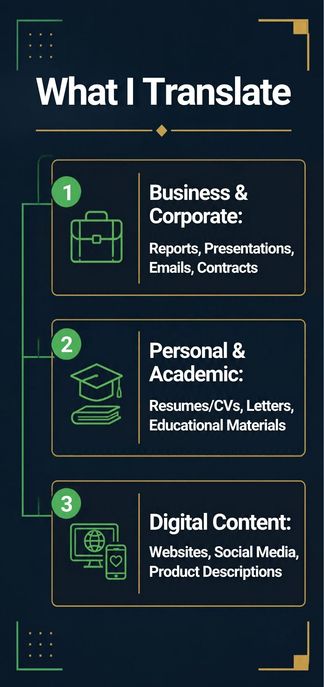
I will accurately translate your documents from Spanish to English or English to Spanish while preserving the original meaning, formatting, and tone.
$100
 firam6432New Seller
I am a professional and dedicated translator with strong language, communication, and proofreading skills. I can accurately translate documents, articles, educational materials, websites, and general content while maintaining the original meaning, tone, and context. I focus on delivering clear, natural, grammatically correct translations and completing assignments accurately and on time. I am detail-oriented, reliable, and committed to providing high-quality translation services that meet each client's requirements.
$100
 Moha New Seller
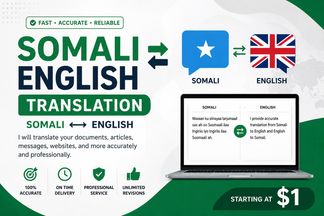
Accurate and clear Somali-English translation for documents, messages, websites, and other content.
$100
 Moha New Seller
I provide accurate Somali to English and English to Somali translation.
$100

 okeowozumaNew Seller
Translation & Editing: Precise translations and thorough edits for documents, websites, and technical content, tailored to your audience. Subtitle Translation & Dubbing: Professional subtitles and dubbing for media, ensuring seamless audio-visual integration. Transcription & Quality Control: Detailed transcriptions and quality checks for audio/video, managing diverse accents and terminology. AI Training & Prompt Evaluation: Optimizing AI content and evaluating prompts for precision and effectiveness. I utilize advanced tools and maintain a strong commitment to deadlines and confidentiality. I’d be delighted to discuss how my expertise can support your projects. Reach me at +44 7451 267794 for further conversation Thank you for your consideration. I’m eager to contribute to your success.
$100
About translation
Translation converts written text from one language into another while preserving meaning, tone and intent. It spans everything from legal contracts and medical records to novels, software interfaces and marketing campaigns. A translator works with the source text in front of them, rendering it accurately in the target language while respecting cultural context, register and audience expectations.
Good translation reads naturally in the target language without feeling like a translation at all. Poor translation produces awkward phrasing, mistranslations of idioms, or text that technically conveys the words but misses nuance, humour or implied meaning. A contract mistranslated can create legal ambiguity; a user interface translated clumsily frustrates everyone who encounters it. The work demands fluency in both languages, subject-matter knowledge, and judgement about when to translate literally and when to adapt.
Translators often specialise by subject area—legal, medical, technical, literary—because terminology and conventions differ sharply. A financial translator knows how balance sheets work in both cultures; a literary translator understands narrative voice and wordplay. Format matters too: subtitles have character limits, websites have SEO considerations, and certified documents require specific attestation. The discipline sits apart from interpreting, which deals with spoken language in real time, and from localisation, which adapts content more broadly for a target market.
Guides related to translation
Translation — questions and answers
- Do translators work from dictionaries or do they already know both languages fluently?
- Professional translators are fluent in both languages but still consult dictionaries, glossaries and reference materials constantly. Language evolves, technical terms vary by industry, and even native speakers need to verify usage, especially for specialised or formal contexts. Dictionaries confirm precision; fluency provides the foundation for natural phrasing and cultural appropriateness.
- What does it mean to translate into your native language, and why does direction matter?
- Most translators work into their native language because producing natural, idiomatic text requires deep intuition about rhythm, collocation and register. Translating into a second language often results in technically correct but stilted prose. The source language is where you need strong comprehension; the target language is where you need native-level writing ability and cultural instinct.
- How do you translate something that has no equivalent word in the target language?
- Translators use several strategies depending on context: borrowing the original term with explanation, finding a functional equivalent that serves the same purpose, or describing the concept in a short phrase. Legal and technical texts sometimes keep source terms in brackets. The choice depends on audience familiarity, available space and whether precision or readability takes priority.
- What's the difference between a certified translation and a regular one?
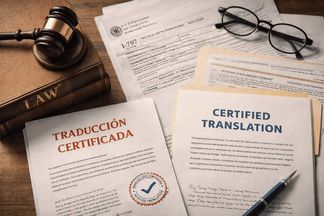
- A certified translation includes a signed statement from the translator or agency attesting that the translation is accurate and complete. It's required for official documents like birth certificates, diplomas or court filings. The certification itself doesn't guarantee quality—it's a legal declaration. Some jurisdictions require translators to hold specific credentials; others accept any qualified professional's certification.
- Why do translation memory tools show partial matches, and should you use them?
- Translation memory software stores previously translated segments and flags similar sentences in new projects, showing percentage matches. A ninety percent match might differ by one word or a verb tense. Translators review these suggestions rather than accepting them blindly, because context changes meaning. The tools speed up repetitive work and ensure consistency across large projects, but human judgement remains essential.
- Can you translate poetry or does it lose too much in the process?
- Poetry can be translated, but it requires different priorities than prose. Translators must choose whether to preserve metre, rhyme, literal meaning, imagery or emotional impact—rarely all at once. Some translations read as poems in their own right; others provide annotated versions that explain wordplay and cultural references. The result is interpretation as much as translation, and multiple valid versions often exist.


